Why Stories Matter in Islamic Learning
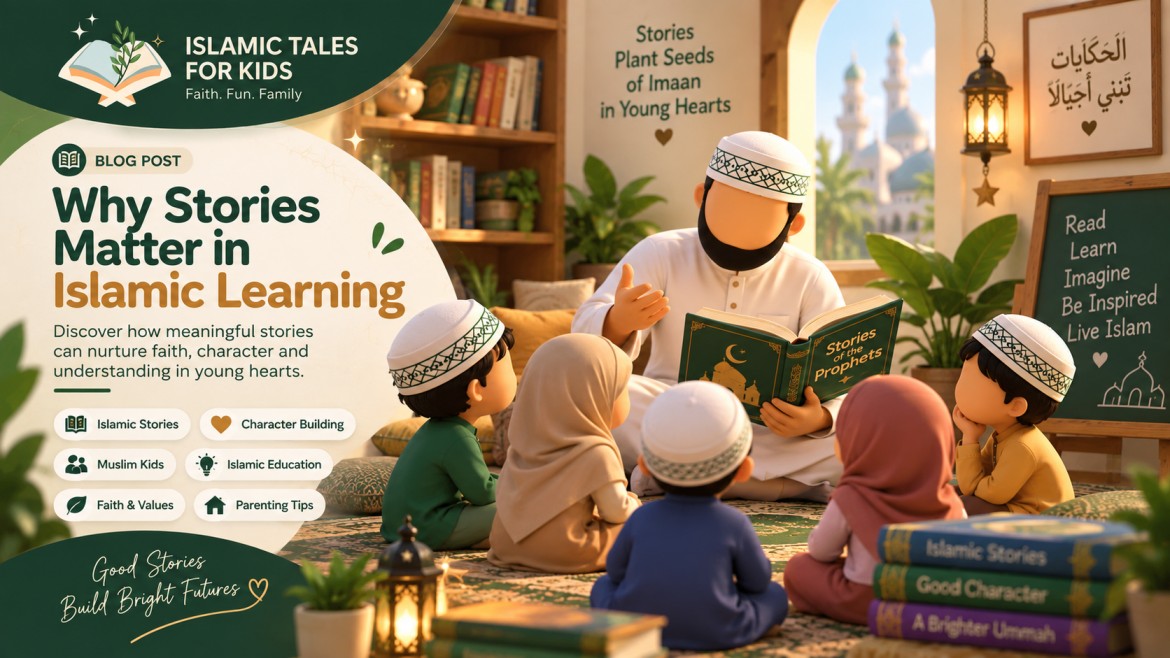
Why Stories Matter in Islamic Learning
Imagine telling a child:
“Be patient.”
They may understand the words.
Now imagine telling them the story of someone who remained patient through a difficult trial and trusted Allah.
Suddenly, patience has a story.
It has a person.
It has a struggle.
It has a lesson.
And that is one reason stories can be so powerful in Islamic learning.
Stories make lessons memorable
Children may forget a definition.
They may forget a list.
But a story can remain in their memory for years.
A child who hears a meaningful story about honesty may remember the character, the situation and the decision that was made.
Later, when they face a similar situation, that memory can come back.
The lesson has moved from information to understanding.
Stories help children understand character
Islamic education is not only about knowing facts.
We want children to develop beautiful qualities:
Honesty.
Kindness.
Patience.
Courage.
Generosity.
Respect.
Trust in Allah.
Stories give children examples of these qualities in action.
Instead of simply saying:
“Be generous.”
we can show them what generosity looks like.
Instead of saying:
“Be truthful.”
we can explore what happens when someone chooses honesty even when it is difficult.
Stories create conversations
After telling a story, don’t immediately move on.
Ask questions.
“What would you have done?”
“How do you think he felt?”
“What can we learn from this?”
“Have you ever experienced something similar?”
These questions transform storytelling into active learning.
Stories help children see themselves
Children often imagine themselves inside the stories they hear.
They ask:
“What would I do?”
That is valuable.
It allows them to think about their own choices and behaviour.
A story about helping someone can encourage them to look for opportunities to help.
A story about forgiveness can make them think differently about a disagreement with a sibling.
Choose stories carefully
Not every children’s story is equally beneficial.
When choosing Islamic stories, parents and teachers should consider:
- Is the story authentic or clearly presented as fiction?
- Does it teach something beneficial?
- Is the language appropriate for the child’s age?
- Does it reinforce sound Islamic values?
- Does it leave the child with a meaningful lesson?
Most importantly, we should avoid presenting invented stories as though they were authentic events from the Qur’an or Sunnah.
The lesson should remain
A good Islamic story isn’t simply a colourful story with a Muslim setting.
There should be something for the child to take away.
Perhaps it is:
“Tell the truth even when it is difficult.”
Or:
“Be kind to others.”
Or:
“Allah sees what we do.”
Or:
“Have patience and trust Allah.”
The story becomes the doorway.
The lesson is what we hope stays behind.
Growing hearts through stories
Children are not only learning with their minds.
They are developing their hearts, habits and character.
When meaningful stories are combined with Qur’an, authentic Sunnah, good teaching and positive example, they can become a beautiful means of nurturing the next generation.
Because sometimes, the simplest way to help a child understand a great lesson…
is to tell them a great story.